DADGAD tuning is one of those things that most guitarists first hear about through Irish or folk music.
(Or Kashmir by Led Zeppelin!)
Someone plays a tune with those big open strings ringing out, and it sounds incredible.
So you retune your guitar, look up a few chord shapes, and then pretty quickly realize that nothing from standard tuning carries over the way you expected.
That first feeling of disorientation is completely normal.
I’ve been playing and teaching in DADGAD tuning for years, and I still remember the early confusion.
The familiar landmarks on the fretboard just vanish.
You end up memorizing a handful of shapes without really knowing why they work or how they connect to each other.
The real shift happens when you stop treating DADGAD as a collection of chord shapes and start understanding how the tuning actually works musically.
That means learning how the open strings relate to each other, how chord systems move across the neck, how modal harmony fits in, and how to navigate the fretboard with confidence instead of guesswork.
This article is not a beginner’s guide to tuning your guitar to DADGAD.
It assumes you already know the basics.
Instead, this is about the next step: understanding how to actually play music in this tuning.
How to think about the fretboard.
How to build chords that make sense.
How to stop getting lost above the fifth fret.
If you have been playing DADGAD tuning for a while but still feel like you are guessing more than you would like, this should help clear things up.
The main reason DADGAD feels confusing is that standard tuning muscle memory stops working.
Every chord shape you have spent years learning is suddenly wrong.
That is genuinely disorienting, especially if you haven’t gone beyond Drop D before.
In standard tuning, most guitarists learn a set of open chord shapes early on.
Those shapes become so automatic that you stop thinking about them.
You just grab a G chord or a C chord and it is there.
In DADGAD, those shapes produce completely different sounds.
Some sound great by accident.
Most do not.
The other issue is that most DADGAD resources online teach shapes in isolation.
You learn a D shape, an A shape, maybe a G shape.
But nobody explains how those shapes relate to each other, why they work, or how to move them around the neck.
So you end up with a small collection of disconnected shapes and no system for finding new ones.
That is where the confusion lives.
It is not that DADGAD tuning is harder than standard tuning.
It is that the usual learning path does not give you the tools to understand the fretboard as a whole.
Once you start seeing the patterns and relationships between shapes, keys, and positions, the tuning opens up quickly.
The problem is almost always a lack of structure, not a lack of ability.
What Makes DADGAD Different From Standard Tuning
To understand DADGAD, it helps to be clear about what actually changes when you retune from standard.
In standard tuning (EADGBE), the six strings use a mix of intervals.
Most strings are a fourth apart, with one major third between the G and B strings.
That inconsistency is part of why standard tuning chord shapes are the way they are.
DADGAD is more symmetrical.
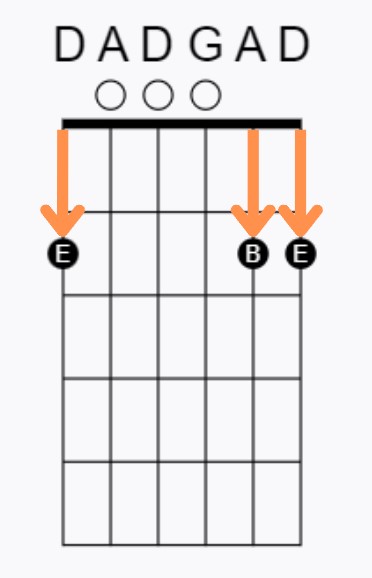
The strings are tuned D, A, D, G, A, D, from low to high.
You have three D strings, two A strings, and one G string.
The tuning is built around a Dsus4 chord, which is why some people call it “open Dsus4.”
Open D tuning is more directly major-sounding, whereas DADGAD stays harmonically ambiguous (Not major or minor).
That suspended quality is one of the reasons DADGAD tuning works so well for accompaniment and modal music.
Many guitarists prefer it because it leaves more space around the melody.
Because the open strings are all D’s, A’s, and one G, you get natural drones and resonance in certain keys.
D and G sound especially open and full.
Other keys work well too, but they require different approaches.
Compared to standard tuning and other alternate guitar tunings, DADGAD gives you:
- Strong open string drones
- Movable chord shapes that are often simpler (fewer fingers needed)
- A natural pull toward modal sounds
- More space and resonance in the low end
The trade-off is that you lose the chord vocabulary you already know.
That is the cost of entry, and it is worth it once you understand how the new system works.
Understanding Drone Strings in DADGAD
Drones are one of the most important features of DADGAD.
If you do not understand how they work, you will miss a lot of what makes this tuning special.
A drone is simply an open string that keeps ringing while you play other notes or chords on top of it.
In DADGAD, the three D strings and two A strings give you constant access to D and A drones.
That is a root and a fifth in the key of D, which is why the tuning sounds so full and grounded when you play in D-based keys.
The low D string (6th string) and the high D string (1st string) can ring open underneath or on top of almost anything you play in D.
The A strings reinforce the harmony.
The G string adds a fourth, which is what gives DADGAD that suspended, open character.
When you are accompanying a tune or song, those drones do a lot of work for you.
You do not always need to fret full chord shapes.
Sometimes letting two or three open strings ring while you move one or two fingers is enough to create a full, musical sound.
This is especially useful in Irish and folk music, where the guitar’s job is to support the melody, not compete with it.
A few practical tips for working with drones:
- Let the low D ring as a bass drone when playing in D or G
- Use the open A strings as a drone when playing in A-based keys
- Experiment with letting the high D string ring open over different chord shapes
- Listen for which open strings clash and which ones support the harmony
Learning to hear and use drones well is one of the fastest ways to make your DADGAD playing sound more musical.

How to Think About the DADGAD Fretboard
One of the biggest problems guitarists face in DADGAD is not knowing where they are on the neck.
In standard tuning, years of practice have given you a mental map.
In DADGAD, that map needs to be rebuilt.
The good news is that the DADGAD fretboard is actually more logical in some ways than standard tuning. Because the tuning is more symmetrical, patterns repeat more consistently.
Start by learning where the D notes are.
You have open D on three strings (6th, 3rd, and 1st).
That gives you anchor points at the nut.
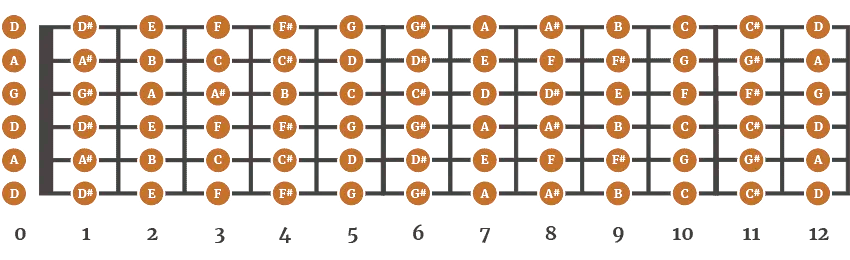
From there, D also appears at the 12th fret on those same strings, and at the 7th fret on the A strings.
Next, learn where the root notes of common keys sit.
If you know where D, G, A, E, and C fall on the 6th and 4th strings, you have a solid foundation for finding chords anywhere on the neck.
A practical way to map the fretboard:
- 6th string (D): Learn the notes up to the 12th fret. This is your bass note reference.
- 4th string (G): Learn the notes here too. Many chord shapes are built from roots on this string.
- Inner strings (A and G): These are where a lot of your melodic movement and chord building happens.
- Outer strings (D’s): These provide the drones and the big open sounds.
You do not need to memorize every note on every string right away.
Start with the root notes on the 6th and 4th strings, and build from there.
The fretboard will start to make sense as you connect those anchor points to chord shapes and scales.
How to Stop Getting Lost on the Neck
Getting lost on the DADGAD fretboard is the single most common frustration I hear from students.
You learn a few shapes near the nut, maybe a couple higher up, and then there is a big gap in between where you have no idea what to play.
Here are some practical strategies that help:
1. Learn root notes on two strings.
Focus on the 6th string and the 4th string.
If you know where D, E, G, A, and C sit on those two strings, you can find a chord in any key quickly.
2. Use the skeleton scale as a roadmap.
The skeleton scale gives you a harmonized path from the nut to the 12th fret.
Instead of jumping between isolated shapes, you have a connected route.
3. Practice moving one shape slowly up the neck.
Take a single chord shape.
Play it at the 2nd fret, 4th fret, 5th fret, 7th fret.
Say the chord name at each position.
This builds your mental map.
4. Connect shapes to real music.
When you learn a tune or song, notice which fret positions you use.
Over time, you build a map based on actual music rather than abstract exercises.
5. Reduce the number of shapes you use.
You do not need 20 chord shapes.
Three or four reliable movable shapes, combined with knowledge of root note positions, will cover most situations.
It is better to know a few shapes deeply than many shapes vaguely.
6. Play along with recordings.
Put on a tune you know and try to find chord shapes at different positions on the neck.
This builds both your ear and your fretboard knowledge at the same time.
The goal is not to know every note on every string.
The goal is to feel confident that you can find what you need when you need it.
Thinking in Shapes vs Thinking in Sound
There is a common trap with DADGAD that catches a lot of players.
You learn a set of chord shapes, memorize where to put your fingers, and then move them around the neck without really hearing what is happening musically.
This is “thinking in shapes.”
It gets you started, but it has limits.
The better approach is to start hearing the relationships between the notes you are playing and the open strings ringing around them.
When you play a chord shape on the DADGAD fretboard, the open D and A strings are almost always involved.
Those drones create a harmonic context that changes depending on where your fretted notes sit.
For example, play a simple two-finger shape at the fifth fret.
Now move it to the seventh fret.
The shape is the same, but the sound is completely different because the relationship between the fretted notes and the drone strings has changed.
One might sound stable and resolved.
The other might sound tense or modal.
The goal is to start hearing those drone relationships instead of just seeing finger positions.
This is how experienced players think and fall into the music during a session.
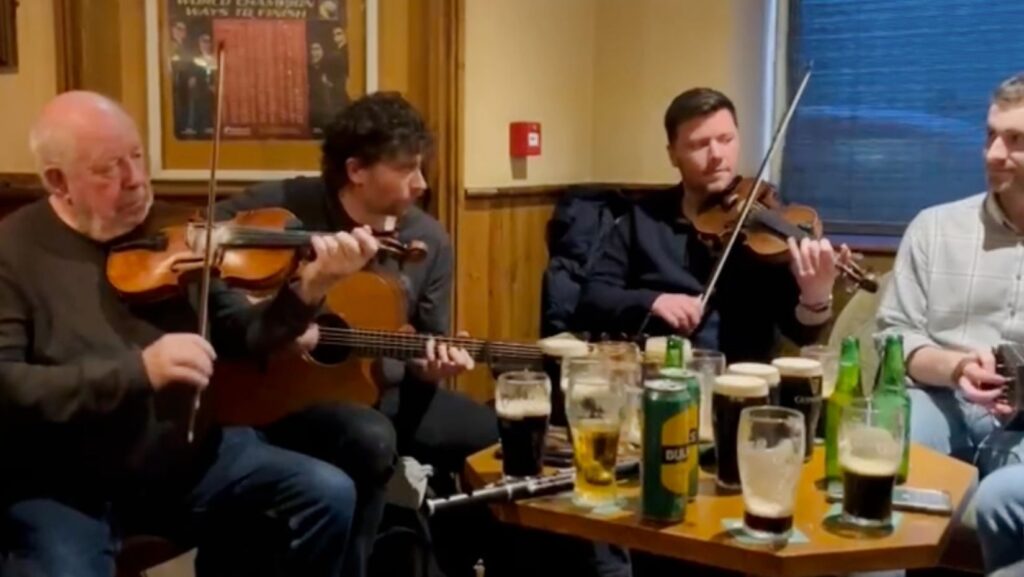
They are not running through a mental library of shape names.
They are listening to how each chord interacts with the open strings and the tonal center of the tune.
A few things that help with this shift:
- Play a shape and let the open strings ring. Listen to the overall sound, not just the fretted notes.
- Move a shape up and down the neck slowly. Notice where it sounds “at home” and where it creates tension.
- When accompanying a tune, focus on whether your chord supports the melody or fights it.
- Practice playing less. Use fewer fingers and more open strings. This forces you to hear the drones.
DADGAD accompaniment works best when you are responding to what you hear, not just executing memorized patterns.
That awareness of tonal center, of how your chord sits against the drone, is what makes the difference between playing shapes and playing music.
Understanding the Skeleton Scale in DADGAD
The skeleton scale is a method I use to help students learn the DADGAD neck efficiently.
It is not a traditional music theory concept you will find in textbooks.
It is a practical tool built specifically for navigating DADGAD.
The idea is simple.
Instead of learning scales as long runs of single notes, you learn harmonized two-note shapes that move up the neck in a logical order.
Each shape uses only two fingers, which keeps things manageable.
And each shape connects directly to a chord, so you are learning the fretboard and your chord options at the same time.
There are two versions of the skeleton scale:
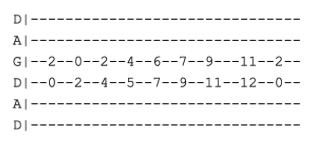
- Inside skeleton scale: Built on the inner D and G strings (3rd and 4th strings). These shapes move up the neck from the open position to the 12th fret. They tend to be smaller, subtler sounds. Great for gentle movement and connecting chord changes.
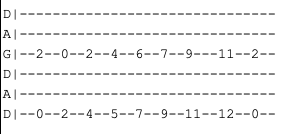
- Outside skeleton scale: Built on the outer D strings (6th and 3rd strings). These shapes use the big open DADGAD tones. They sound fuller and more resonant.
In practice, you might use the inside shapes for smooth, quiet movement during a verse or a gentle passage.
Then you bring in the outside shapes when you want more volume, more ring, or more presence.
Because each shape only uses two fingers, it is also a great starting point for building bigger chords later.
Once you are comfortable with the skeleton shapes, you can add extra notes to fill out the sound.
But the skeleton gives you the foundation.
This approach works for both major and minor keys.
You learn the major skeleton scale first, then the minor version.
Between the two, you cover most of what you need for basic Irish and folk accompaniment.
If you want a quick reference for the core shapes and patterns in DADGAD, the free DADGAD cheatsheet covers the essentials in one place.
Major skeleton scale tutorial:
Minor skeleton scale tutorial:
Movable Major/Minor Chord Systems
Movable Major Chords in DADGAD Tuning
One of the best things about DADGAD tuning is that major chord shapes are movable.
Once you learn a shape, you can slide it up and down the neck to play different major chords.
The most common movable major shape in DADGAD is built with the root on the 6th string (the low D).

At the open position, this gives you a D major sound.
Move it up two frets and you get E major.
Move it to the fifth fret and you get G major.
Here is a simplified view of how a basic movable major system works:
| Root Fret (6th String) | Chord |
|---|---|
| Open | D |
| 2nd fret | E |
| 4th fret | F# |
| 5th fret | G |
| 7th fret | A |
| 9th fret | B |
The key point is that you do not need dozens of different shapes.
A small number of movable shapes, combined with an understanding of where the root notes fall, gives you access to major chords all over the neck.
Start with one or two shapes and practice moving them to different frets.
Say the chord name out loud as you move.
This builds the connection between the shape, the sound, and the fretboard position.
Movable Minor Chords in DADGAD Tuning
Minor chords in DADGAD follow the same movable logic as major chords.
Learn the shape, find the root note, and slide it to the fret you need.
The most common minor shapes in DADGAD often feel slightly different from what you might expect.
Because the open strings are A, and D, minor chords in certain positions will have open strings ringing that add color or tension.
Sometimes that sounds beautiful.
Sometimes you need to mute a string to keep things clean.

A basic movable minor shape with the root on the 6th string gives you D minor at the open position (with some careful fingering), G minor at the 5th fret, and so on up the neck.
A few things to keep in mind with minor chords in DADGAD:
- Listen to the open strings. They may or may not work with your minor chord. In some positions, the open A or D strings add a nice drone. In others, they clash.
- Muting is a skill. Learning to lightly mute strings you do not want ringing is part of playing clean minor chords in DADGAD.
- Minor chords near the nut sound different from minor chords higher up. The open string interaction changes the character of the chord depending on position.
As with major shapes, start with one reliable minor shape and get comfortable moving it.
Then add a second shape with a different voicing.
Two or three good minor shapes will cover most situations.
Higher Voicings and Upper Neck Shapes
Many DADGAD players get comfortable in the first five frets and rarely venture higher.
That is a missed opportunity.
Some of the most useful and beautiful voicings in DADGAD live between the 5th and 12th frets.
High chord shapes tend to have a different character.
They are often brighter, thinner, and more focused.
Because you are further from the nut, the open strings (if you let them ring) create wider intervals against your fretted notes.
This can produce really interesting harmonic textures.
A practical way to explore high voicings:
- Take a movable shape you already know and play it at the 7th fret, then the 9th, then the 12th.
- Let the open strings ring and listen to how the sound changes at each position.
- Try fretting just two notes high on the neck while the open D and A strings drone underneath.
High shapes are especially useful for:
- Creating contrast during a tune (playing low for verses, high for choruses or repeated sections)
- Adding brightness to an arrangement
- Playing in a higher register when another guitarist is covering the low end
- Finding chord voicings that do not crowd the melody
You do not need to learn dozens of high shapes right away.
Even two or three reliable voicings above the 5th fret will expand your playing significantly.
The skeleton scale concept mentioned earlier is helpful here too.
The inside skeleton shapes naturally guide you up the neck in a logical way, giving you chord options at every position.
Understanding Modal Harmony in DADGAD Tuning
Modal harmony is one of the reasons DADGAD sounds the way it does, and it is also one of the areas that confuses guitarists the most.
In simple terms, a mode is a type of scale that has its own specific sound or mood.
You are probably already familiar with major (Ionian) and minor (Aeolian) sounds, even if you do not use those names.
Modes like Dorian and Mixolydian are very common in Irish and folk music.
DADGAD is naturally suited to modal music because of the open strings.
The D and A drones create a harmonic bed that does not strongly push toward major or minor.
This leaves room for modal melodies to sit on top without clashing.
Here is a quick reference for the modes you will encounter most often:
| Mode | Character | Common In |
|---|---|---|
| Ionian | Major, bright | Songs, some tunes |
| Dorian | Minor with a raised 6th, warm | Irish tunes, folk songs |
| Mixolydian | Major with a flat 7th, driving | Reels, jigs, dance tunes |
| Aeolian | Natural minor, darker | Ballads, slower tunes |
You do not need to memorize mode theory in an academic way.
What matters is recognizing the sound and knowing which chord choices support it.
For example, if a tune has a Mixolydian feel (major but with a flat 7th), you might avoid using a standard major 7th chord and lean into shapes that include that flat 7th instead.
In DADGAD tuning, the open strings often handle this naturally.
The practical takeaway: listen to the melody.
If it sounds major but with a slight twist, it is probably Mixolydian.
If it sounds minor but warmer than expected, it might be Dorian.
Let the melody guide your chord choices rather than forcing a major/minor framework onto everything.
Applying DADGAD to Real Music
Understanding chord systems and fretboard patterns is important, but it only matters if you can apply it to actual music.
DADGAD is a practical tuning.
It is meant to be used.
In Irish and folk music, the guitar’s primary role is accompaniment.
You are backing melodies played by fiddles, flutes, concertinas, pipes, or voices.
The guitar supports the rhythm, fills out the harmony, and keeps the energy moving.
It should not overpower the melody.
Good DADGAD accompaniment involves:
- Rhythm. Matching the lift and feel of the tune type. Reels, jigs, polkas, and songs all have different rhythmic feels.
- Dynamics. Playing louder in energetic sections and pulling back during quieter moments.
- Space. Not every beat needs a chord. Leaving gaps lets the melody breathe.
- Drones. Using open strings to add depth without cluttering the sound.
- Chord choice. Picking chords that support the melody rather than imposing a harmony that does not fit.
DADGAD tuning also works well beyond Irish music.
Folk, singer-songwriter, acoustic fingerstyle, and Celtic music all benefit from the open resonance and modal flexibility of the tuning.
The principles are the same: support the song, listen to what is happening around you, and respond musically.
When you start applying what you have learned to real tunes and songs in DADGAD, the theory becomes practical.
You stop thinking about shapes and start thinking about music.
A useful exercise: pick one tune you enjoy and try accompanying it using only two or three chord shapes.
Focus on rhythm and feel rather than complexity.
Simple backing that locks in with the melody almost always sounds better than busy chord changes.
Here’s a full tutorial lesson in DADGAD for a tune called ‘Rolling in the Ryegrass’.
It’s a nice steady tune and not a bad place to jump into Irish music using DADGAD tuning.
Using a Capo in DADGAD Tuning
A capo changes the key of your open strings without changing the chord shapes you already know.
In DADGAD, this is extremely useful because it lets you use the same movable shapes and drone relationships in different keys.
Without a capo, DADGAD naturally centers around D.
The open strings give you D and A drones, which work best in D-related keys.
Put a capo on the second fret, and your open strings now sound like E, B, E, A, B, E.
You are still playing the same shapes, but everything sounds in E.
The drone relationships stay the same relative to the capo.
Here are the most common capo positions and the keys they open up:
| Capo Position | Open String Key Center | Common Use |
|---|---|---|
| No capo | D | D, G, A, modal keys around D |
| Capo 2 | E | E, A, B |
| Capo 3 | F | F, Bb (less common) |
| Capo 5 | G | G, C, D |
| Capo 7 | A | A, D, E |
The important thing to notice is that the shapes stay the same.
Your fingers do not need to learn new patterns for each key.
You just move the capo and the whole system shifts.
This is one of the reasons DADGAD tuning works so well for session playing and accompaniment.
If someone calls a tune in G, you can put the capo on the fifth fret and use your familiar D shapes.
Knowing a few solid capo positions saves you from having to figure out entirely new fingerings for every key.
I have no shame in using the capo in sessions.
It sounds great and it’s very handy.
What more is there to say.
Playing without the capo in DADGAD has its place in too, and I teach how inside the Key Mastery Bundle.
Recommended Lessons and Next Steps
If this article has given you a clearer picture of how DADGAD works, the next step is to start applying these ideas to real music.
Here are some practical places to go from here:
- DADGAD chords. If you want to build a stronger foundation with the core shapes and chord families, the DADGAD chords page covers the essentials.
- Songs in DADGAD. Applying what you know to actual songs is one of the best ways to learn. The songs in DADGAD page has a growing collection of song lessons and accompaniment guides.
- Free DADGAD cheatsheet. If you want a simple one-page reference for the core chord shapes and patterns, you can grab the free DADGAD cheatsheet. It is a handy thing to have next to you while you practice.
- Structured learning. If you want a more guided path through DADGAD, including movable chord systems, rhythm, accompaniment, tune lessons, song lessons, and live workshops, that is what I am building inside the Irish Guitar Academy. It is designed to give you the structure and progression that random YouTube videos cannot.
The most important thing is to keep playing.
Pick a tune, pick a song, grab a chord shape, and start applying what you have learned.
The fretboard makes more sense the more you use it with real music.
Frequently Asked Questions
What is DADGAD tuning used for?
DADGAD tuning is used for accompaniment, melody playing, and fingerstyle guitar across many genres, with Irish traditional, Celtic, and folk music being the most common.
The tuning works well for backing tunes and songs because of its open drones and movable chord shapes.
It is also used by singer-songwriters and acoustic guitarists who want a more resonant, modal sound.
Why does DADGAD feel confusing at first?
DADGAD feels confusing because all the chord shapes and fretboard knowledge from standard tuning stop working.
You lose your familiar landmarks and have to rebuild your understanding of where notes and chords are.
Most guitarists also learn DADGAD shapes in isolation without a system to connect them, which adds to the feeling of being lost.
Why does DADGAD tuning sound so open and resonant?
The tuning uses three D strings and two A strings, which means strumming open gives you a Dsus4 chord with lots of sympathetic resonance.
Those repeated notes across multiple strings create natural drones that ring underneath whatever else you play.
This open, suspended quality is what gives DADGAD its distinctive sound.
Is DADGAD good for Irish and folk music?
DADGAD is one of the most popular tunings for Irish and folk guitar.
The open drones, modal flexibility, and rhythmic possibilities make it well suited to accompanying reels, jigs, songs, and other traditional tune types.
Many professional Irish guitarists use DADGAD as their primary tuning.
How do I stop getting lost on the DADGAD fretboard?
Focus on learning root notes on the 6th and 4th strings first.
Then use a small number of movable chord shapes and practice sliding them to different fret positions while naming the chords.
Tools like the skeleton scale concept can give you a connected path up the neck instead of isolated shapes scattered across the fretboard.
Can you use a capo in DADGAD tuning?
Yes, and it is one of the most practical tools available.
A capo lets you shift the key center of the open strings while keeping the same chord shapes and drone relationships.
Common capo positions include the 2nd fret (key of Em), 5th fret (key of G), and 7th fret (key of A).
Do I need to relearn the guitar for DADGAD?
You do not need to start from scratch, but you do need to learn new chord shapes and fretboard patterns.
The good news is that DADGAD shapes are often simpler than standard tuning shapes, sometimes requiring only one or two fingers.
Your general guitar skills like rhythm, picking, and musicality all carry over.
It is the chord knowledge and fretboard map that need rebuilding.
Conclusion
DADGAD tuning makes a lot more sense once you stop seeing it as a collection of random shapes and start understanding the systems behind it.
The drones, the movable chord families, the skeleton scale, the modal harmony, and the fretboard logic all connect to each other.
It is one tuning with a coherent structure.
The most useful thing you can do right now is pick one area from this article and spend some focused time with it.
Maybe that is learning root notes on the 6th string.
Maybe it is trying the skeleton scale concept.
Maybe it is taking a tune you already know and experimenting with chord positions higher up the neck.
Small, steady progress beats trying to absorb everything at once.
The fretboard opens up one piece at a time, and every piece you understand makes the next one easier.